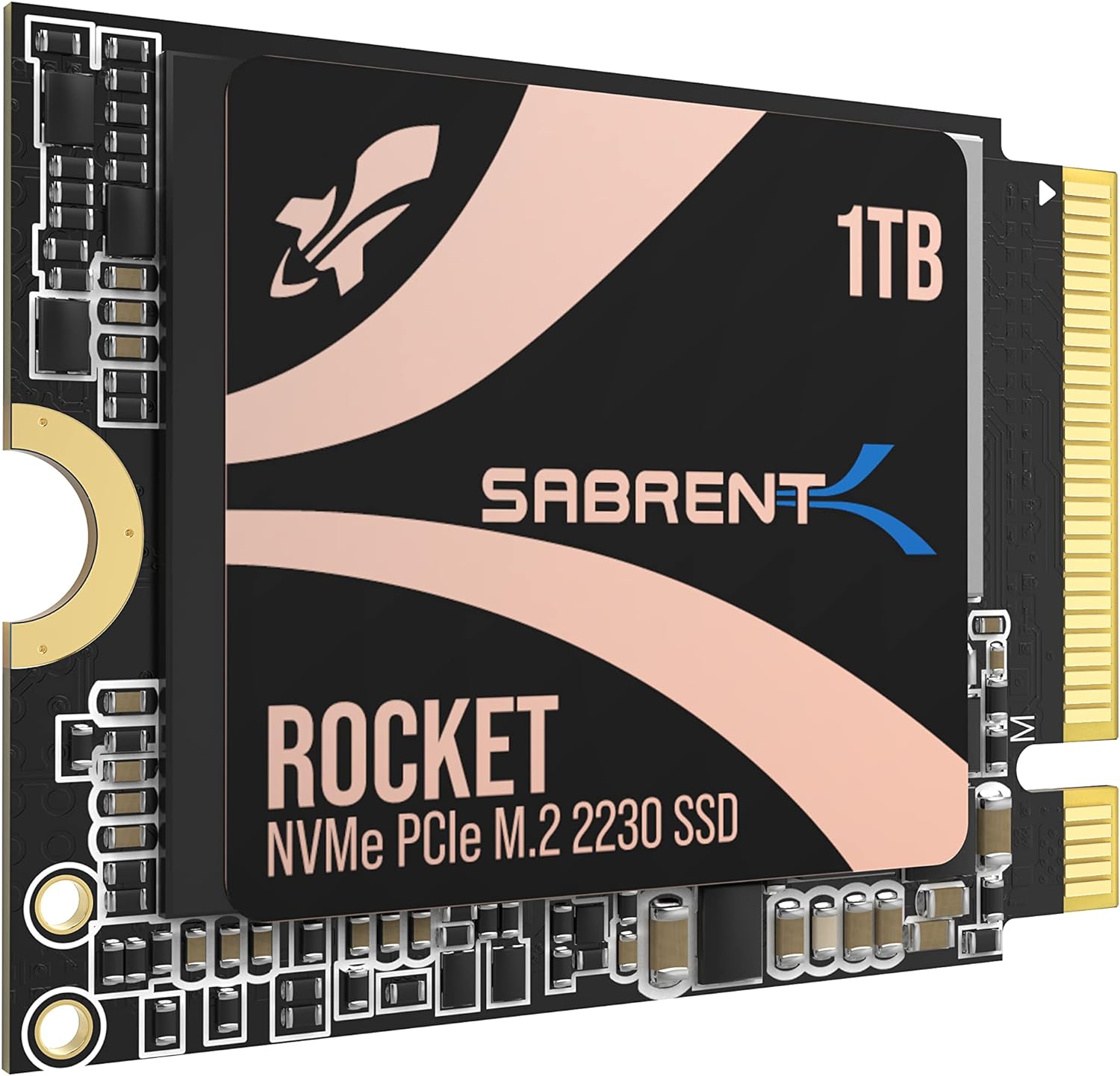
💰 Minimum 1TB NVMe for gaming. Add a 2TB+ HDD for media if needed
FILTERS
🔍
SORTVIEW
ProductTypeCapacityReadValuePrice
Rocket 2230 1TB NVMe SSD – PCIe Gen4 M.2 2230 Internal SSD for Steam Deck, Surface Pro, ROG Ally – Up to 5000 MB/s Ge...
Sabrent★★★★★4.8🔥 DEAL -$43
NVMe
1TB
3.4GB/s
S
$249.99
$206.95
2 stores
Specifications
asinB0BQG6JCRP
reviews2705
UPC840025259379
Model #SB-2130-1TB
Weight20 Grams
Capacity1TB
FormNVMe
PCIeGen4
Form FactorM.2 2230
TypeNVMe
InterfaceNVMe
Read3.4GB/s
Write3.0GB/s
nandTLC
DRAM CacheYes
value20
read5000
pcieGen4
Form FactorM.2 2230
PERFORMANCE
60%
Customer Reviews★★★★★5.0 · 5 reviews
★★★★★Great upgrade for the Surface Pro 8
I had read a lot of horror stories about upgrading the M.2 NVMe drive on the Surface Pro 8 (SP8). There were a lot of stories about overheating and BSOD when trying to re-install Windows. When I saw this Sabrent drive advertised on Amazon it specifically said Surface Pro compatible and that it ran cool, so I took a chance on it. I am very pleased with the result. I'll do the TL;DR part up front: I upgraded my 256GB M.2 Drive on my Surface Pro 8 with the 1 TB Sabrent Rocket 2230 NVMe M.2 drive, and the drive runs great at PCIe 4.0 Speeds according to CrystalMark 8. No BSOD and runs under 50 Celsius *EDIT*: Under maximum load, about 35 degrees celcius degrees idle/normal operations *END EDIT* according to CrystalDiskInfo 8. I was able to copy all of my files using Acronis partitioning software you get to use free from Sabrent when you purchase their drive. If you want to know exactly how I copied everything over without ever having to go into the BIOS, keep reading: UPFRONT DISCLAIMER: You will need to purchase three things to do this upgrade if you don't have them already. Two of them you would need anyway if you were to upgrade like Microsoft suggests: #4 Torx screwdriver/bit, thermal compound, and an external NVMe drive enclosure. 1) First I did purchase an external NVMe enclosure to copy the old drive to the new one. You can find them on Amazon for under $30 US. You need to make sure the enclosure can take 2230 size drives. I got one that had USB C to USB C cable and was thunderbolt compatible. Another consideration is that after you swap the NVMe drives you can use the enclosure with your old drive and have another high speed hard drive to back stuff up on, although I found you will need an NVMe thermal pad/heatsink for the old drive or it can overheat. 2) After reading about BSOD NVMe upgrade horror stories on the SP8 it lead me to articles talking about AHCI Link Power Management - HIPM/DIPM. HIPM/DIPM power management is not on by default and you actually have to do a Windows registry edit to make it available. There are some good guides on how to do this via a quick google search. I recommend you enable it and turn the feature on. 3) I had to disable drive encryption before copying files over (it is on by default). You can either disable encryption or get a USB encryption key. I chose to decrypt the drive which will take hours depending on how much data you have on the drive. You can re-encrypt once everything is over to the new drive. THIS NEXT PART IS WHERE MOVING FILES OVER AND GETTING WINDOWS SETEP ON THE NEW DRIVE DIFFERS FROM WHAT MICROSOFT WANTS YOU TO DO. 4) I cannot stress enough the kudos to Sabrent for having their own disk partition software. Acronis, which you can get from Sabrent's website, will copy all of your files over for you verbatim; no reinstalling necessary. Follow the disk cloning prompts, and the best part is it will automatically increase the size of your main windows drive to maximum while keeping your boot partition and recovery partition intact (just make sure you chose the correct cloning prompt). Acronis alone makes it worth it to go with Sabrent. 5) The SP8 comes with a front and back metal sleave for the NVMe drive. YOU WILL NEED a #4 Torx screwdriver bit (very tiny!) to unscrew the drive and screw it back in. The metal casing snaps off (do so gently so as not to bend the casing). I cleaned off the thermal compound the old drive had, put in the Sabrent drive, re-applied some CPU thermal compound I already had, and put the casing back together, then screwed it back into the SP8. A lot of videos show using a thermal pad instead of re-using the Microsoft drive enclosure. I think the drive enclosure helps distribute heat evenly back into the SP8 chassis. I turned the SP8 on and it recognized me with all of my files intact without ever having to go into the BIOS the first time. I have been running normally for almost two weeks and not a single issue. Drive runs cool and fast. Works great and couldn't be happier. I hope this helps you out if you are on the fence!
Ben B · 2023-01-11 · via amazon
★★★★★Exceptional quality and speed!
The SABRENT Rocket 2230 NVMe 4.0 1TB SSD was the perfect addition to my ASUS ROG Ally handheld build, providing much-needed additional storage space and performance. Assembling a compact and powerful gaming device required careful consideration of storage options, and the Rocket 2230 NVMe SSD fit the bill perfectly. Its compact form factor and high-speed PCIe 4.0 interface seamlessly integrated into the build, offering blazing-fast read and write speeds for smooth gaming experiences. With 1TB of storage capacity, I have ample space to store my favorite games, apps, and media files without worrying about running out of space. The reliability and performance of the SABRENT SSD have exceeded my expectations, contributing to the overall success of my handheld gaming setup. If you're looking to upgrade your gaming device with additional storage and speed, I highly recommend the SABRENT Rocket 2230 NVMe 4.0 1TB SSD. It's a game-changer!
Joe GoodVibes · 2024-02-21 · via amazon
★★★★★2 years later and still flawless
I’ve been using this mini NVMe drive in my Steam Deck for about two years now with zero complaints. It was super easy to install, instantly recognized, and more than doubled my storage space. Load times are fast, performance has stayed consistent, and it’s handled all my games without a hiccup. Definitely one of the best upgrades I’ve made for the Deck.
Ben says · 2025-10-10 · via amazon
★★★★★If upgrading a Surface Pro 8, you need to read this
PCIe Gen 4 drives do have a compatibility issue with Surface Pro 8 and possibly 9 too were it randomly reboots and is very unstable. This drive does work without any issues if you make the following changes before cloning existing drive to it. I get double the speed from my stock drive at 4600MB/s read speeds and battery last around 6 hours (same as my stock) at 120Hz refresh, 50% brightness and using the keyboard at lowest backlight setting and just browsing the web over Wifi 6. Drive temperatures stayed at 41C or below at high load. This is what you need to do before cloning. Step #4 is necessary for stable upgrade without random reboots. 1.) Update Windows 11 to 22H2 2.) Download the latest firmware updates for Surface Pro 8, there are some recent ones. Launch the surface app and verify that you have the latest. These are my versions. SAM: 11.101.139.0 UEFI: 18.102.141.0 3.) Turn off bitlocker so the drive is decrypted, you can turn bitlocker again after you replace the drive. 4.) In control panel, search for an applet called Power Options, it's under the advance power settings when you try to edit the Power plan. Under PCI Express, change PCI Express -> Link Power State Management to Moderate Power Savings, default is maximum power savings, this was what was causing random reboots for me. This is the only change that is needed from the default factory image that ships with Surface Pro 8. 5.) Clone to Sabrent drive using an external USB C enclosure that can house a 2230 ssd (there are several sold here). You can use their free Acronis tool from Sabrent's website. I personally used Macrium Reflect free version to clone as it kept the partitions the same as before, Acronis does merge the partition's which causes issues when trying to do a factory reset or recovery as partition will not be found. 6.) Swap the drives. I did not re-use the metal surface pro ssd enclosure, I instead added .5mm thermal pad directly to the top of the Sabrent Drive, it fits nicely. With 1mm thermal pad, the magnetic door did not close, so .5mm is only choice. Max temperature at high load was 41c. 7.) Boot to your new drive, test to make sure its stable, you can re-enable bitlocker to encrypt drive again. There is an optional setting you can set before or after the clone, which may give you better battery life. There is a hidden power setting in Power Options under Hard disk called AHCI Link Power Management - HIPM/DIPM By default it's already set to HIPM (Host Initiated Power Management), you can set this setting to Lowest for battery to give you deeper sleep states if supported, the drive still wakes up fast regardless of the power state. To enable this setting in Power Options you can add this to the registry. Create a text file in notepad that ends in .reg extension, example "Add_AHCI_Power_Setting.reg" without quotes. Copy and paste registry setting below (line starts with [HKEY....) into the file and save it, double click the file in file explorer to add this setting into your registry (when prompted, click yes). This option will now show up in Power Options under Hard disk. For battery, set to Lowest, for Plugged In, you can set to Active (There is no power management with this option), for faster performance. [HKEY_LOCAL_MACHINE\SYSTEM\CurrentControlSet\Control\Power\PowerSettings\0012ee47-9041-4b5d-9b77-535fba8b1442\0b2d69d7-a2a1-449c-9680-f91c70521c60] "Attributes"=dword:00000002
Immier · 2023-01-16 · via amazon
★★★★★Installed into Steam Deck with no headaches
I'm happy with this drive. It came well presented in a copper package and felt like a quality product. I used this to replace the SSD that came with my Steam Deck for more space. Aside from having to open up the Deck, which isn't difficult, this went right in without any fuss. I then used a bootable Linux with Gparted and the dd command to clone the old drive to the new one using a NVME dock. Then, the deck booted right up. I was happy to get the extra SSD space, and it is a little faster than the old one, though I don't really notice in games, as in most even the SD cards it's hard to really notice. As this is a 2230 form factor drive, it is a bit more expensive than 2280 drives as it has to use larger and more expensive flash modules rather than many smaller ones. Still, I felt the value was good.